
Innovate Urban
Driving Impact Through Consulting & Communications
Tata Steel Foundation
Content / Publication For Livelihood Management
Jamshedpur, India


About The Project
In 2023, Tata Steel Foundation (TSF) commissioned Urban Innovation Lab (UIL) under a consolidated assignment titled “Content / Publication for Livelihood Management.” The mandate covered two major verticals: the Disha Programme focused on women’s leadership and gender inclusion, and a portfolio of integrated livelihood initiatives implemented across Jharkhand and Odisha.
The Disha Programme aimed to address structural gender disparities by building grassroots women leaders and strengthening social inclusion mechanisms. With a target of training 6,000 women leaders by 2027 and direct engagement of 4,000 women, the programme positioned women as local change-makers capable of influencing community-level transformation.
Parallelly, TSF’s livelihood portfolio included WADI Orchard development, Pond-Based Integrated Farming Systems (IFS), Lac cultivation, Tasar cultivation, Dairy development and Watershed management. These initiatives were designed to enhance income security, improve productivity, strengthen institutions and promote climate-resilient rural development. Together, these programmes engaged thousands of farmers and households, contributing to sustainable economic advancement and resource optimisation.
The core objective of the assignment was not limited to reporting outcomes. TSF intended to create structured, insight-driven, replication-ready knowledge products that captured programme design, implementation processes, measurable impacts and grassroots narratives. The documentation was envisioned as a strategic resource for stakeholders, practitioners and institutions seeking to replicate or learn from the model.
Description of actual services provided in the assignment:
Urban Innovation Lab undertook comprehensive documentation, assessment and publication development for both the Disha Programme and the integrated livelihood initiatives.
Understanding and Planning Phase:
UIL initiated the assignment through detailed consultations with TSF to understand programme architecture, impact pathways and documentation expectations. Continuous coordination ensured alignment with TSF’s strategic objectives. Initial contextual assessments were conducted to frame gender and livelihood realities at global, national and regional levels.
Data Collection and Field Engagement:
UIL developed structured data collection checklists and engaged extensively with field staff, trainers, project leads and beneficiaries. The assignment involved over 100 hours of research and 50+ hours of stakeholder interactions. Qualitative narratives were documented empathetically, while quantitative performance metrics were analysed to establish measurable impact. Special emphasis was placed on capturing grassroots perspectives and lived experiences.
Programme-Specific Documentation:
- Disha Programme: Comprehensive impact documentation capturing women’s leadership journeys, implementation challenges and institutional learnings.
- WADI Orchard Programme: 45-page project document and 70-page case study compendium documenting transformation across 19 villages and measurable income growth.
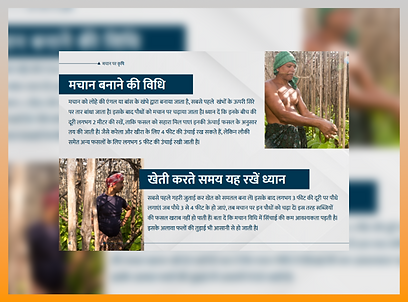
- Pond-Based IFS: 45-page project report, 35-page case study document and 13 region-specific farming manuals in local language to support replication.
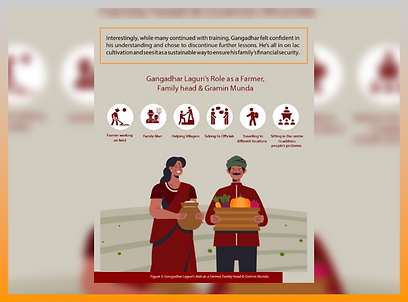
- Lac Cultivation: 35-page project document and 70-page case study compilation detailing productivity increase and value chain strengthening.
- Tasar Cultivation: 50-page project and 50-page case study document highlighting biodiversity conservation and income enhancement.
- Dairy Development: 50-page project document and 25-page case study documentation capturing institutional strengthening and productivity gains.
- Watershed Management: 40-page project report and 65-page case study documentation focusing on soil-water conservation and agricultural productivity.
Report Development and Design:
UIL compiled and structured over 1,000 pages of professionally designed reports, manuals and case studies. The documents followed a strong narrative architecture while maintaining formal reporting standards. Each publication was designed for readability, strategic insight and replication utility.
Communication and Coordination:
The team implemented structured coordination mechanisms, including shared digital platforms, documented meeting minutes and iterative review processes to ensure clarity and consensus throughout the assignment.
Through this integrated and methodical approach, UIL delivered a comprehensive knowledge repository that translated complex field interventions into structured, accessible and professionally designed publications, strengthening TSF’s institutional documentation and enabling wider dissemination of its development model.