
Innovate Urban
Driving Impact Through Consulting & Communications
NuSocia
Editing & Graphic Design of Report on Waste Management
Copy Editing and Designing


About The Project
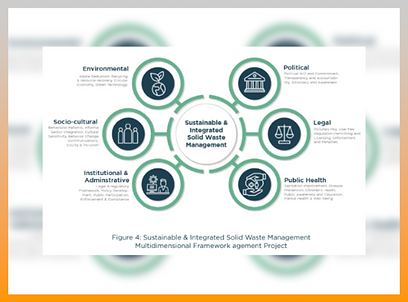
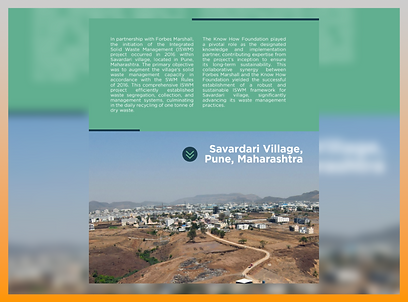
The Forbes Foundation, in strategic alliance with the Know How Foundation, spearheaded an Integrated Solid Waste Management (ISWM) initiative in Sawardari village, Pune. The project was aligned with India’s 2015 Solid Waste Management Rules and aimed to strengthen the village’s waste segregation, collection, and treatment infrastructure. The overarching goal was to establish a sustainable and scalable waste management model in a peri-urban context.
Financial Outlay and Community Integration
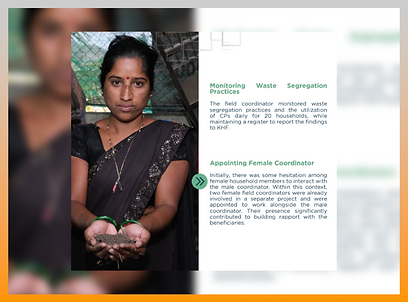
The total financial outlay for the initiative amounted to ₹ 94,05,380, with compost sales generating ₹ 76,86,786, demonstrating strong fiscal sustainability. The implementation strategy was deeply rooted in community engagement. Orientation sessions were conducted with the Gram Panchayat and local residents to ensure awareness, beneficiary selection, and effective utilization of compost planters at the household level.
Operational Milestones and Environmental Impact
Key operational milestones included the establishment of a decentralized waste collection system and the development of dedicated composting sites for organic waste. The project enabled the systematic management of 1.327 metric tons of waste daily and processed 1,491.412 metric tonnes of wet waste. Environmentally, the initiative contributed to the avoidance of 621.422 metric tons of CO2 emissions, aligning with broader sustainability and climate goals.
Impact Assessment and Project Documentation
The project’s impact was independently evaluated by NuSocia, a specialist impact assessment organization. The evaluation assessed environmental outcomes, community participation, and socio-economic benefits. To document and communicate the project’s success, a professional copywriting and design firm was commissioned to develop a comprehensive narrative and visual representation, capturing implementation processes, challenges, and measurable outcomes.
Services Provided
Urban Innovation Lab (UIL) played a pivotal role in translating complex environmental and operational data into an accessible and compelling narrative. Leveraging expertise in sustainability communication, UIL transformed intricate statistics into clear, visually engaging infographics and structured documentation that effectively conveyed the project’s scale and impact.
Technical Content Strategy
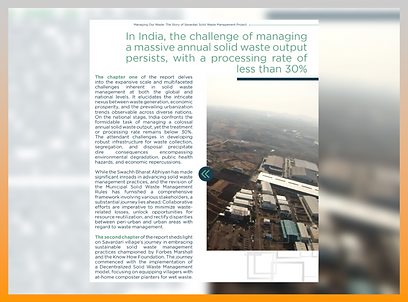
UIL adopted a strategic approach to technical storytelling, ensuring scientific accuracy while maintaining readability. The team articulated key project transitions—such as the evolution of waste management systems—and highlighted measurable environmental gains, including reductions in carbon emissions. This balance between technical depth and clarity strengthened stakeholder understanding.
Report Quality and Stakeholder Engagement
Through meticulous copy editing and structured report development, UIL produced a high-quality and technically precise document. The report’s clarity and analytical rigor facilitated engagement with diverse stakeholders, including local authorities, sector leaders, and institutional partners. Its effectiveness as a communication tool strengthened the project’s positioning as a sustainable model.
Policy Influence and Community Outreach
By presenting technical achievements in a relatable and accessible format, UIL helped bridge the gap between environmental data and actionable insights. This approach supported policy-level discussions and encouraged other communities to explore similar sustainable waste management frameworks.
Technical Design and Brand Elevation
UIL’s technical design capabilities further elevated the project’s documentation. The use of licensed software, professional imagery, and structured visual layouts enhanced both readability and credibility. The polished presentation reinforced the project’s reputation as a benchmark initiative in sustainable waste management.
Overall, UIL’s integrated communication, technical writing, and design expertise significantly enhanced the visibility, credibility, and replicability of the ISWM initiative, positioning it as a model for future sustainability-driven interventions.