About The Project
The Tata Steel Foundation Livelihood Programs Documentation Project focused on the comprehensive assessment and documentation of multi-sector rural livelihood initiatives implemented across Jharkhand and Odisha.
These programs were designed to promote sustainable development, strengthen rural economies, and empower communities through skill development, natural resource optimization, value-chain strengthening, and institutional capacity building.
The engagement required capturing the scale, socio-economic impact, technical interventions, and long-term sustainability models of diverse livelihood verticals including horticulture, integrated farming, lac and tasar cultivation, dairy management, and watershed development.
Each initiative addressed region-specific challenges while contributing to a broader goal of resilient rural development and enhanced income security.
Services Provided
Urban Innovation Lab (UIL) was appointed to undertake extensive research, impact assessment, documentation, and knowledge development across all livelihood verticals. The engagement involved 100+ hours of field research and 50+ hours of stakeholder consultations, resulting in detailed project documentation, training manuals, and beneficiary case studies.
WADI Orchard Program Documentation
UIL documented the transformation of 500 acres of wasteland into productive horticultural plantations. The documentation highlighted financial upliftment of beneficiaries, many earning approximately INR 110,000 annually. Deliverables included a comprehensive project report and 16 in-depth beneficiary case studies.
Pond-Based Integrated Farming System (IFS)
The team analyzed integrated farming models covering fishery, livestock, poultry, and vegetable cultivation. Income enhancements averaging INR 75,000 annually were documented. UIL produced a detailed project report, a 500-page Hindi training manual, and 20+ beneficiary case studies based on analysis of data from over 9,000 farmers.
Lac Cultivation Program
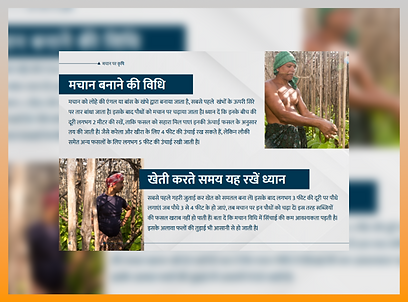
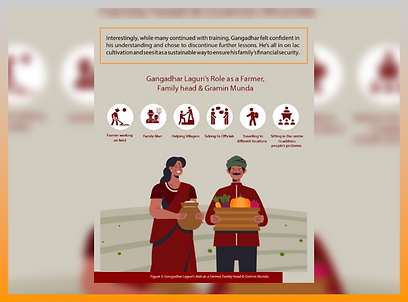
UIL conducted strategic documentation of forest orchard establishment, lac cultivation techniques, and institutional strengthening mechanisms. Deliverables included 16 farmer case studies and a 300-page technical training manual focused on improving yield, soil moisture management, and value realization.
Tasar Cultivation Project
The Tasar initiative documentation covered scientific rearing practices, seed zone development, value chain enhancement, and yarn production units. The project emphasized technical skill development and income sustainability for rearers.
Dairy Management Program
UIL developed a comprehensive narrative of the dairy value chain, including livestock enhancement, cooperative development, bulk milk cooling systems, and milk ATM innovations. Deliverables included 25 farmer case studies and a 300-page training manual supporting dairy entrepreneurs.
Watershed Management Project
The watershed documentation highlighted construction of 28 farm ponds in Noamundi (1.79 million cubic feet water storage), soil and moisture conservation across 1,150 hectares in Kukru, and transformation of 18.31 hectares into mango and guava orchards with micro-drip irrigation. The project also documented empowerment of 100 women in Kuiani and capacity-building of 832 trained farmers.
Overall Impact
UIL’s approach combined statistical rigor, field validation, and narrative storytelling to produce structured documentation that not only captured program design and implementation but also demonstrated measurable socio-economic impact and long-term sustainability outcomes across rural communities.