
Innovate Urban
Driving Impact Through Consulting & Communications
CEPT Research & Development Foundation (CRDF)
Research Study on Urban Wastewater Reuse in Maharashtra
Maharashtra, India
Research Study


About The Project
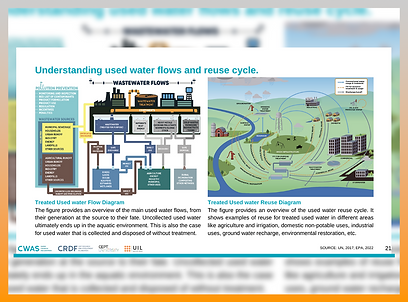
The Centre for Water and Sanitation (CWAS) at CEPT University has worked extensively with the Urban Development Department and the Government of Maharashtra on urban water and sanitation for over a decade. With the launch of Swachh Bharat Mission (SBM) 2.0 in 2021, the focus expanded to include liquid waste management, emphasizing environmental, social, and financial sustainability in urban sanitation systems. Cities were tasked with developing wastewater treatment and reuse solutions—an especially complex challenge for smaller towns where infrastructure is often inadequate. The Maharashtra Government initiated efforts to explore effective wastewater reuse strategies, particularly in towns with populations under 100,000. CWAS proposed a comprehensive study to identify policy- and project-level challenges in wastewater reuse in smaller cities. CRDF appointed UIL to support this initiative through a structured scope of work.Policy and Regulatory Ecosystem Review
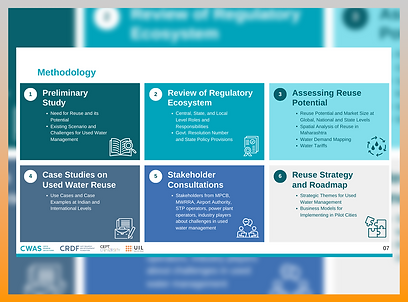
- Assessment of existing policies governing urban wastewater reuse across residential, commercial, industrial, and agricultural sectors.
- Review of government resolutions, water tariffs, and supply arrangements.
- Analysis of national schemes including AMRUT and SBM 2.0.
Wastewater Reuse Potential Assessment
- Evaluation of urban water demand and supply gaps.
- Assessment of wastewater generation, treatment capacity, and reuse opportunities.
- Geographic and market size analysis, including ongoing STP projects.
Use Cases and Examples
- Review of wastewater reuse models in small and medium towns.
- Analysis of business models, technologies, and institutional frameworks.
- Examination of prior CWAS studies and cross-sector examples.
Implementation Opportunities and Barriers
- Identification of policy, financial, technological, and institutional challenges.
- Assessment of tariff structures and their impact on reuse adoption.
- Stakeholder consultations for practical insights.
Wastewater Reuse Strategy and Roadmap
- Development of reuse options based on city size, agroclimatic zones, and reuse typologies.
- Evaluation of contract structures and institutional arrangements.
- Stakeholder validation of roadmap applicability.
Services Provided
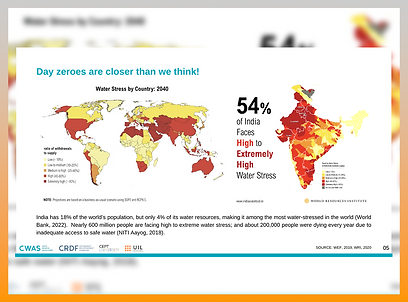
UIL conducted a comprehensive assessment of India’s water security landscape within the broader context of global water challenges. The review incorporated reports from WRI, NITI Aayog, UNEP, KfW, and ADB, highlighting environmental, economic, and public health implications of mismanaged wastewater.Policy and Institutional Analysis
- Review of constitutional provisions including the 7th and 12th Schedules, clarifying roles of central and state governments.
- Chronological analysis of national and state wastewater policies with emphasis on AMRUT 2.0 and SBM 2.0.
- Creation of an institutional responsibility matrix identifying functional gaps.
- Detailed review of Maharashtra State Water Policy 2019 mandating 30% wastewater recycling.
Market and Financial Assessment
- Estimation of India’s wastewater market at USD 2.4 billion (2019), projected to reach USD 4.3 billion by 2025.
- Comparative analysis revealing only 4% wastewater reuse in Maharashtra.
- Financial review of state budgets highlighting inadequate sewerage tax coverage.
- Cost comparison of wastewater treatment technologies versus freshwater sourcing.
Geographical and Technological Analysis
- GIS-based assessment of water demand, scarcity, and priority districts.
- Review of global case studies from UAE, Qatar, Florida, Mexico, Barcelona, Namibia, Jordan, Japan, and others.
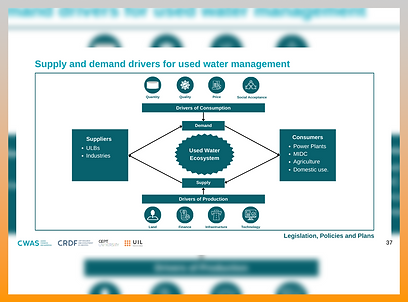
- Evaluation of parameters including land, finance, infrastructure, technology, and social acceptance.
Stakeholder Consultations
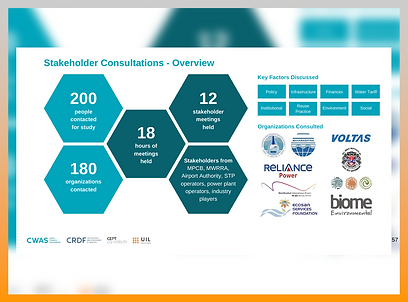
- Engagement with 200+ participants through 18 hours of consultations.
- Identification of key policy, infrastructure, finance, tariff, institutional, environmental, and social issues.
Strategic Roadmap Development
- Roadmap to increase wastewater reuse from 4% to 40%.
- Identification of 13 strategic themes across infrastructure, governance, technology, and monitoring.
- Capital investment estimation of Rs. 19,000 crores and operational costs of Rs. 2,500 crores.
- Proposal for State Reuse Mission and wastewater management rules.
- Design of state-level institutional committee structure.
- Assessment of carbon savings potential and GST implications.