About The Project
The Wastewater Reuse Strategy & Policy Advisory assignment was undertaken in collaboration with the Centre for Water and Sanitation (CWAS) at CEPT University, in partnership with the Urban Development Department, Government of Maharashtra.
With the launch of Swachh Bharat Mission (SBM) 2.0, India intensified its focus on liquid waste management, emphasizing environmentally sustainable and financially viable wastewater treatment and reuse systems, particularly in smaller towns with populations under 100,000.
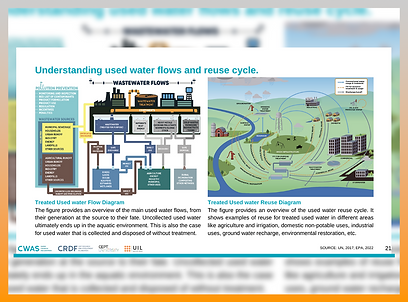
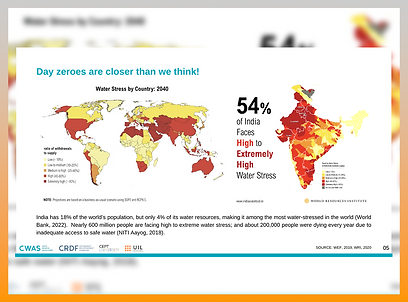
Recognizing the growing challenges of urban water stress and inadequate reuse infrastructure, CWAS proposed a comprehensive study to assess wastewater reuse potential, policy bottlenecks, market dynamics, and implementation barriers across Maharashtra. UIL was engaged to provide research, analysis, and strategic advisory support to develop a structured roadmap for scaling wastewater reuse across small and medium-sized towns.
Services Provided
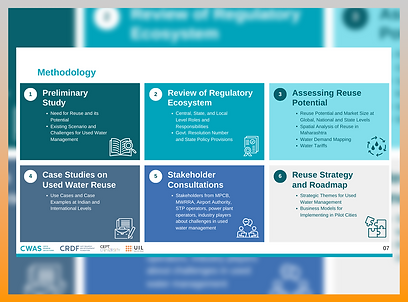
The engagement covered policy analysis, market assessment, institutional review, stakeholder consultation, and development of a long-term strategic roadmap for wastewater reuse expansion in Maharashtra.
Policy & Regulatory Ecosystem Review
A comprehensive review of national and state-level policies was conducted, including AMRUT 2.0, SBM 2.0, Maharashtra State Water Policy 2019, and relevant constitutional provisions under the 7th and 12th Schedules. The study examined tariff structures, government resolutions, institutional mandates, and regulatory gaps affecting wastewater reuse adoption.
Water Security & Global Benchmarking Analysis
Extensive literature reviews were undertaken using reports from WRI, NITI Aayog, UNEP, KfW, ADB, and global case studies from UAE, Qatar, Florida, Namibia, Jordan, Japan, and Barcelona. Comparative insights were drawn to understand high-reuse economies and adaptable best practices for Maharashtra.
Wastewater Market & Financial Assessment
A market analysis estimated India’s wastewater market growth from USD 2.4 billion (2019) to USD 4.3 billion (2025). Financial viability studies examined treatment costs versus freshwater sourcing, highlighting economic advantages of reuse while identifying structural barriers such as groundwater over-extraction.
Geospatial & Demand-Supply Analysis
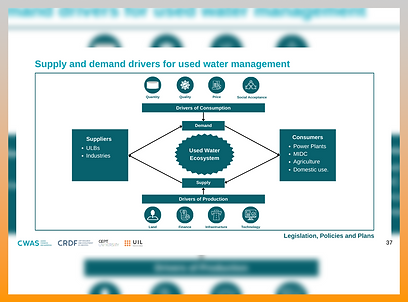
GIS-based geographic analysis was conducted to assess water demand, scarcity patterns, wastewater generation, and district-level priority mapping. Treatment infrastructure coverage and reuse potential were evaluated across towns under 100,000 population.
Institutional & Functional Gap Mapping
A functional matrix was developed outlining roles and responsibilities across national, state, and Urban Local Body (ULB) levels. Gaps in implementation authority, financing mechanisms, monitoring systems, and institutional coordination were identified.
Stakeholder Consultations
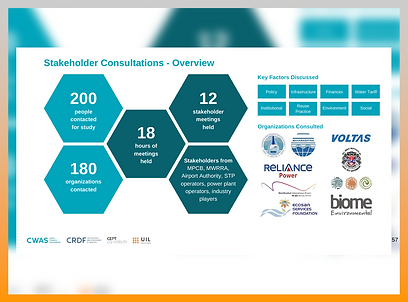
A large-scale stakeholder engagement exercise involving over 200 participants and 18 hours of consultations was conducted. Discussions covered policy barriers, financial constraints, infrastructure deficits, tariff reforms, social acceptance, and environmental compliance challenges.
Technology & Reuse Model Evaluation
Comparative analysis of wastewater treatment technologies and reuse business models was undertaken, evaluating parameters such as capital cost, land requirements, operational efficiency, environmental impact, and scalability potential.
Strategic Roadmap Development
A phased roadmap was developed to increase wastewater reuse levels in Maharashtra from 4% to 40%. Thirteen strategic themes were identified covering infrastructure expansion, institutional reform, financing models, regulatory frameworks, monitoring systems, environmental safeguards, and public awareness initiatives.
Financing & Resource Mobilization Plan
A capital investment plan estimating ₹19,000 crores in capital expenditure and ₹2,500 crores in operational costs was prepared. The roadmap included GST considerations, financing mechanisms, resource mobilization strategies, and proposal for a State Reuse Mission with defined governance structures.
The project delivered a structured, data-driven, and financially grounded wastewater reuse strategy aimed at strengthening urban water security, enhancing environmental sustainability, and improving long-term resilience across Maharashtra’s small and medium towns.