
OPINION | URBAN POLICY | INDIA
The ₹15,000-Crore Ghost Train
Madhya Pradesh’s metro is now a wedding venue. Hyderabad’s just bankrupted Larsen & Toubro. Delhi’s drowning in ₹30,835 crore of JICA debt. Behind India’s mass-transit theatre is a national policy already written, repeatedly ignored — and a fix that does not require a single new rupee of borrowing.
01 THE PHOTOGRAPH
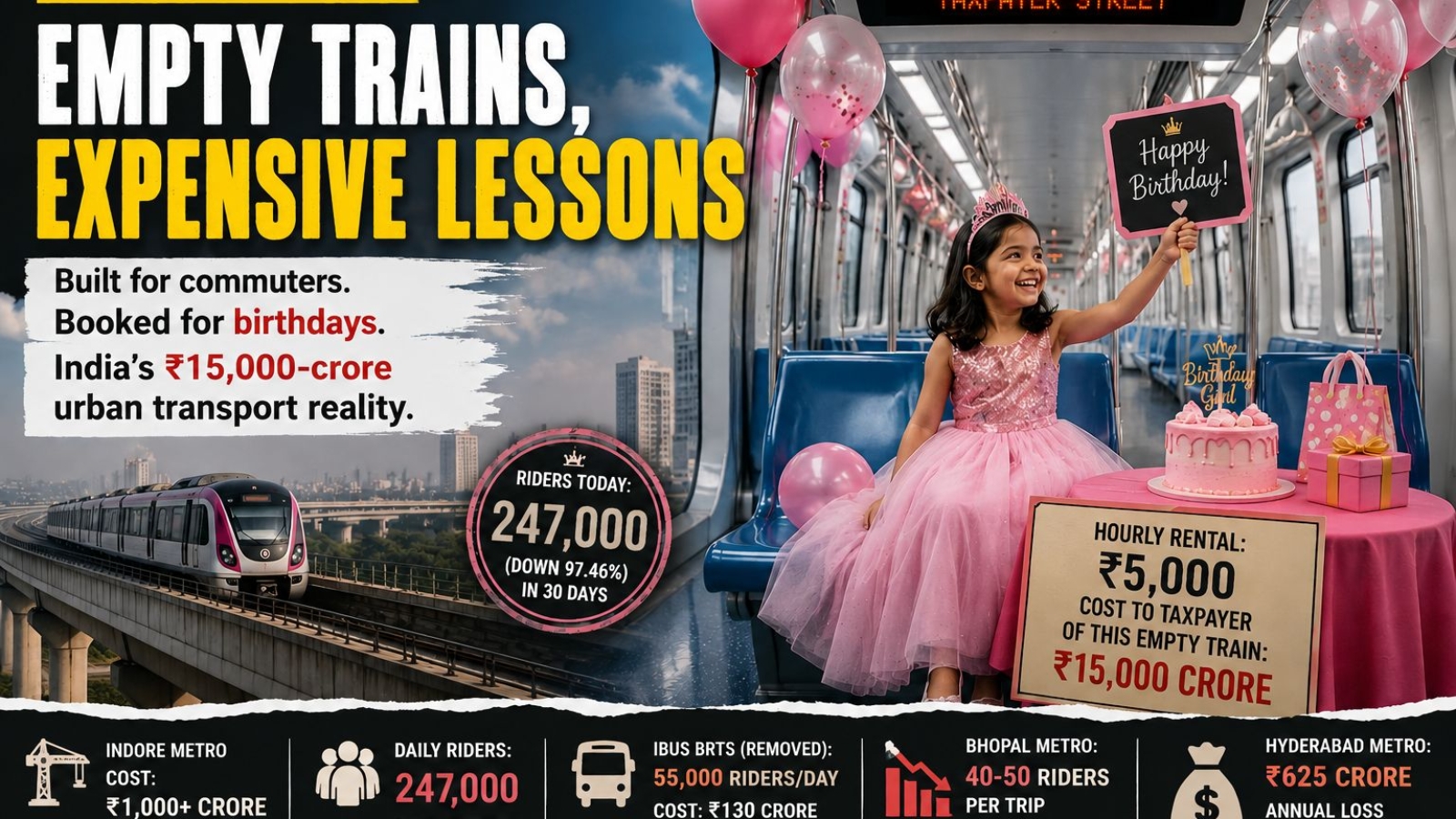
Imagine the photograph. A child in a sequinned birthday gown, holding a balloon. Behind her, the polished blue floor of an Indore Metro coach. The platform empty. The frame perfect. Cost to the family: ₹5,000 an hour. Cost to the Indian taxpayer of the empty stage on which this photograph was taken: ₹15,000 crore.
This is not satire. This is the official launch product of the Madhya Pradesh Metro Rail Corporation in May 2026, branded “Celebrations on Wheels” — a state-owned mass-transit operator monetising its own emptiness.
The numbers behind that photograph are worse than the photograph itself.
When Indore’s Super Priority Corridor opened on 31 May 2025, 26,803 people rode it on day one. By 1 July — thirty days later — daily ridership had collapsed to 680. A 97.46% fall in one month. Six months on, the line had moved 247,000 passengers cumulatively — fewer than the Delhi Metro carries before lunch on a Wednesday. Bhopal’s Orange Line, opened with similar fanfare in December 2025, was carrying 40 to 50 commuters per trip by February 2026. By April, services were trimmed to nine trips a day, between 11 a.m. and 4:30 p.m. The system’s official 2027 ridership target is 2.5 lakh passengers per day.
It is currently delivering 0.27% of that.
“A 99.73% gap between promise and performance is not a teething problem. It is the signature of a planning system that has lost its way.”
02 THE WORKING SYSTEM WE TORE DOWN
There is a bitter irony at the heart of this story that almost no one is telling.
In December 2024, the dismantling of Indore’s Bus Rapid Transit System — the iBus corridor on AB Road — was announced, citing “traffic congestion.” At the time, the BRTS was carrying over 55,000 commuters every day on a single 11.7-kilometre stretch built for ₹130 crore in 2013. By comparison, the entire 6-km Indore Metro Super Priority Corridor, built for over ₹1,000 crore, was carrying 680.
We tore down a system that moved 55,000 people a day, at one-tenth the per-kilometre cost, on the argument that private cars deserved more lane space — and replaced it, in the same city, with an elevated metro nobody yet uses.
Read that sentence again. It contains the entire pathology of Indian urban transport in one act.
Indore did not have a transport problem. It had a transport-policy problem.
03 THE GHOST OF CHRISTMAS FUTURE — HYDERABAD
If MP Metro is the canary in the coal mine, Hyderabad is the dead canary on the floor.
In April 2026, Larsen & Toubro — the engineering giant that had bet ₹16,375 crore on Asia’s largest public-private metro partnership — formally exited Hyderabad Metro Rail. The state government took over a project carrying ₹13,000 crore in debt and ₹6,000 crore in accumulated losses. L&T’s own public filings acknowledged that the project’s commercial development plans — leasing land and real-estate ventures — had not yielded the expected revenues. The original financial model assumed 60% of income would come from non-fare sources. Eight years in, only 40% does.
Hyderabad has 4.5 lakh daily riders — roughly six hundred and sixty times Indore’s current ridership — and still loses ₹625 crore a year. Daily revenue covers daily operations; debt servicing alone pushes the system into permanent red. The Telangana government’s response has been to refinance ₹13,538 crore of 8–10% commercial debt with a 3–4% Indian Railway Finance Corporation loan over 20 years. That is not a turnaround strategy. That is changing who pays the bill.
This is the future Indore and Bhopal are walking towards. Slowly, in slow motion, with a state government already absorbing a ₹600-crore-a-month operating deficit on a system whose private partner concluded was unsalvageable.
04 WHAT THE POLICY ALREADY SAYS
Here is where the analytical reader should sit up.
The Government of India’s Metro Rail Policy 2017 — the document that governs every metro project seeking central financial assistance — already mandates almost every fix that India’s metros have failed to implement.
It is not a matter of needing new policy. We have ignored the existing one.
The policy makes the following compulsory for any project receiving central funding:
A Comprehensive Mobility Plan for the city
A prerequisite for sanctioning a metro alignment, not an afterthought to justify it.
A Unified Metropolitan Transport Authority (UMTA)
A statutory body, tasked with planning, coordination, and financing of urban transport across the metropolitan region. UMTAs are mandatory for accessing central financial assistance.
A mandatory TOD chapter in the DPR
With proposed intermodal integration, universal accessibility, walkways, NMT paths, public bike sharing, parking lots for cycles and personal vehicles, and arrangements for receiving and dispatching feeder buses at every station.
Value Capture Financing through Betterment Levies
On properties whose values rise because of metro proximity, with statutory backing in the project DPR.
Stake-holding by the urban local body or development authority
In the metro SPV, ensuring land-use and transport decisions are taken under the same roof — not in two warring bureaucracies.
Central financial assistance is conditional on these. And yet.
Madhya Pradesh has no operational UMTA. Indore’s Comprehensive Mobility Plan is over a decade old and predates the metro alignment it is meant to inform. There is no Betterment Levy in force around any metro station in Bhopal or Indore. The MPMRC SPV does not include a meaningful stake for the Municipal Corporation. Feeder bus arrangements at most stations are aspirational. The “TOD chapter” exists on paper.
“This is the part that should provoke real anger. The rules were already written. We chose to skip them.”
05 HOW PROFITABLE METROS ACTUALLY WORK
Now consider what countries that built modern metros several decades before us learnt the hard way.
Hong Kong: Rail + Property
Hong Kong’s MTR is owned 70% by the government and 30% by the public. It operates 221 km of railway, carries 5 million passengers a weekday, runs on schedule 99.9% of the time, and posted a profit of HK$14.5 billion in 2021. It receives zero government subsidy.
The mechanism is called Rail-plus-Property. The government grants MTR development rights on the land above and around its stations and depots, valued at “without-railway” prices. MTR pays a land premium at that pre-railway value, builds the line, and partners with private developers to build offices, malls, and apartments above and around the stations. MTR captures a share of the development profit. By the time the line opens, the catchment is already dense, walkable, mixed-use, and full of commuters who do not need a car to use the system.
More than half of MTR’s income comes from property activity. In the first half of 2025 alone, property profits surged 218.5% to HK$5.5 billion. The metro funds the city. The city does not fund the metro.
Tokyo: The Private Railway Plus Real-Estate Model
JR East — a single private operator — moves 17 million passengers a day on 12,300 trains, generates US$26 billion in annual revenue, receives no government subsidy, and earns roughly one-third of revenue from retail, hotels, and station-adjacent real estate. Tokyo’s other private railways — Tokyu, Odakyu, Keio — have been doing this since the 1920s. Each functions simultaneously as a transport operator and as a master-planned real-estate developer. The trains exist because the property businesses make money. The property businesses make money because the trains exist. Neither survives alone.
Singapore: One Authority, One Decision
Singapore’s MRT achieves 101% farebox recovery on operations because the entire island is governed by a Land Transport Authority working hand-in-glove with the Urban Redevelopment Authority and the Housing & Development Board. Every public housing block — and 80% of Singapore’s population lives in public housing — is sited with explicit reference to MRT catchments. There are no isolated decisions about land and rail. There is one decision, with multiple instruments.
The common thread is not technology, not fares, not even ridership. It is governance. In every profitable metro on earth, somebody owns the integrated decision: where the line goes, where the homes go, where the offices go, where the buses feed in, who pays the betterment, and how the surplus is captured.
In every Indian metro, that integrated decision-maker does not exist.
06 THE MATHEMATICS OF MISALLOCATION
Let us do the calculation Indore deserves.
The Indore Metro Phase 1 capital cost is approximately ₹15,000 crore for 33.53 kilometres of Yellow Line — about ₹447 crore per kilometre once interest and land are included. (The bare construction figure of ₹182 crore per kilometre understates it.) At today’s daily ridership of around 680 passengers, the per-passenger capital cost works out to roughly ₹22 crore per daily rider — a number you would not pay even for a private jet.
Operating costs continue regardless: traction power, signalling staff, station upkeep, depreciation, JICA interest. Conservatively, an elevated metro of this scale runs an annual operating bill of ₹150–200 crore. At 680 daily riders paying an average of ₹30 per ride, fare-box revenue is ₹74 lakh a month — under ₹9 crore a year. The system is haemorrhaging at least ₹15 lakh per hour, every hour, day after day.
What ₹15,000 crore could have bought instead
About 7,500 modern electric city buses — enough to serve every MP city above 100,000 population at world-class frequencies for a decade. Or 15 fully integrated BRTS corridors of 30 km each, capable of moving 5 lakh people per day per corridor. Or comprehensive footpath, NMT, and feeder-bus networks for every Tier-2 city in central India, with money left over for the metro. Or, if we had still wanted the metro, the same ₹15,000 crore wrapped inside a TOD value-capture programme would have come close to paying for itself by year ten.
Add in the cost of inaction. The Lancet’s Global Burden of Disease study put India’s annual economic loss from air pollution at US$36.8 billion in 2019 — 1.36% of GDP, with Madhya Pradesh among the five worst-affected states. Every empty metro train and every dismantled BRTS lane is a private vehicle journey we forced back onto Indore’s choking roads.
07 THE PARETO PRESCRIPTION
If 80% of metro outcomes flow from 20% of decisions, here is the 20% — costed, sequenced, and grounded in the 2017 Policy that already exists.
Year 1: Governance and Catchment
Notify a statutory UMTA for both Indore and Bhopal under a state UMTA Act — Karnataka, Tamil Nadu, and Telangana already have models to copy. Cost: ₹5–10 crore in setup, recovered many times over in coordination savings.
Notify a 500-metre TOD belt around all 29 Indore Metro stations and all Bhopal Metro stations, with mandatory FAR bonuses (3.5–4.0 against the current 1.5–2.5) and a Betterment Levy of 20–30% on the FAR uplift. At conservative Indore commercial-land values of ₹15,000–25,000 per sq.m, this could yield ₹4,000–6,000 crore over a decade — enough to retire roughly a third of project debt.
Year 2: Feeder and Integration
Procure and deploy a feeder fleet sized at 1.5 buses per station — about 45 buses for Indore at ₹1.2 crore per electric bus — running every 7 minutes during peak hours. Cost: ~₹55 crore, financed through a national CCEA-cleared FAME-style scheme.
Implement a single mobility card valid on metro, feeder bus, AICTSL bus, and IPT auto-rickshaws, with a 10% discount for inter-modal transfers. Cost: ~₹15 crore in IT and reader infrastructure.
Deploy demand-responsive parking pricing in the catchment of every station — ₹50 per hour for the first hour, ₹100 thereafter, in a 500-metre radius — which both nudges riders to the metro and generates ₹100–200 crore a year for the UMTA.
Year 3: Land and Land Use
Complete a citywide redrawing of the master plan around the metro spine, with mixed-use zoning, no parking minimums in TOD zones, and active street frontages. This is policy work, not capital work.
Open joint development at metro depots and large station plots through transparent tendering — Indore’s Gandhi Nagar and Bhopal’s depot lands are 100 acres each. Hyderabad’s L&T model failed because it was carrying 8–10% commercial debt; a state-backed development corporation, with the Indore Municipal Corporation and IDA holding stakes, can borrow at 5–6% and outperform on returns alone.
The other 80% of effort — branding campaigns, station-naming rights, Celebrations on Wheels, mascots, photoshoot fees — moves the needle by 5–10% on a good day. They are not wrong. They are simply not the cake.
08 THE LARGER QUESTION
Indore and Bhopal are not unusual. They are early.
Twenty Indian cities are in some stage of metro planning — Patna, Surat, Agra, Kanpur, Meerut, Nagpur, Coimbatore, Visakhapatnam, Thiruvananthapuram, Madurai, the Indore–Ujjain Vande Metro, and others. Together, they will commit upwards of ₹3 lakh crore in capital expenditure over the next decade. If they each replicate the Indore–Bhopal pattern — concrete first, governance later, TOD perhaps, feeder probably never — the cumulative loss will dwarf India’s entire urban-transport budget for a generation.
This is not an argument against metros. It is an argument against building metros without building cities.
A metro line is one of the most expensive pieces of urban infrastructure a society can build. It earns its return only when it is wrapped in dense land use, fed by reliable buses, embedded in unified governance, and financed in part by the value it creates around itself. Without those four wrappers, it is not a transport system. It is a monument.
The question for Madhya Pradesh, and for the next ten Indian cities lining up at the metro counter, is not how to fill empty trains with wedding parties.
“It is whether we are willing to bake the cake before we sell the icing.”
The photograph in the Indore Metro coach is not an awkward marketing experiment. It is a snapshot of an urban policy that has run out of cake.
SOURCES
Deccan Herald (May 2026 – MPMRC Celebrations on Wheels); MetroRailNews and Construction World (Indore Super Priority Corridor ridership data); Knocksense (Bhopal Orange Line operations data); MoHUA Metro Rail Policy 2017 (PIB release; mohua.gov.in); ADB India Transit-Oriented Development & Land Value Capture report (2022); The Week and IndiGlobal Media (April 2026 – L&T exit from Hyderabad Metro); Telangana NavaNirmana Sena (HMR FY24-25 financial summary); LinkedIn analyses on DMRC FY24 financials (₹5,104 cr net loss; JICA debt ₹30,835 cr); McKinsey & Co. and World Bank LVC Casebook (MTR Rail+Property); Streetsblog SF / SPUR (JR East financials); Tokyo Metro IPO disclosures; Down To Earth (Indore BRTS dismantling and iBus ridership); Wikipedia (Indore Metro, Hyderabad Metro, Indore BRTS); The Lancet Planetary Health (Global Burden of Disease – India air-pollution economic loss).
Add a Comment