
An analysis of where the cleanest city’s money actually comes from, where it really goes, and the questions every Indori should be asking.
A tale of two numbers
On 7 April 2026, Mayor Pushyamitra Bhargav presented the Indore Municipal Corporation’s budget for FY 2026–27. The headline figure: ₹8,455 crore. A year earlier, the figure was ₹8,175 crore. The year before that, ₹8,302 crore. Big numbers, no new taxes, lots of projects.
Now consider another number. According to IMC itself, the corporation collected ₹1,086.92 crore in actual revenue in FY 2025–26 — up from ₹932 crore the previous year. That’s the money IMC genuinely raised from Indoris through property tax, water charges, solid waste fees, building permissions, and other levies.
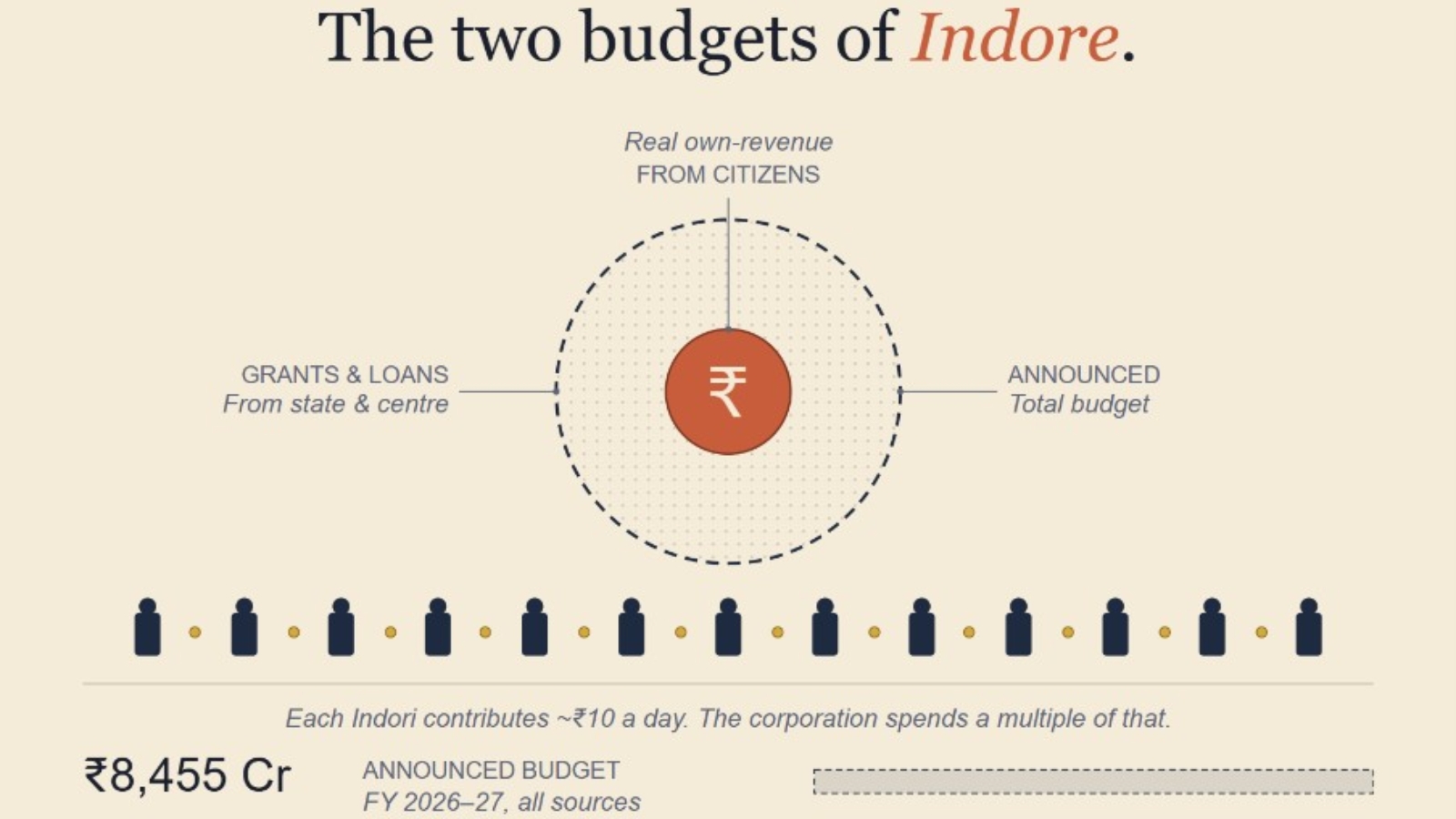
These two numbers — ₹8,455 crore announced and ~₹1,087 crore actually collected from citizens — describe two very different cities. The first is a city of grand projects funded by state grants, central schemes, and borrowings. The second is the city’s own working balance sheet —the part it controls, and the part that tells you whether Indore is becoming financially self-reliant or merely well-subsidised.
This article reads IMC’s finances the way a citizen should: not by the size of the headline, but by what each rupee buys, where it comes from, and what it hides.
Where does the rupee really come from?
For an honest read, the most useful frame isn’t the announced budget — it’s IMC’s audited financial statements, available on the Ministry of Housing and Urban Affairs’ City Finance portal.
For FY 2022–23 (the latest fully audited year), IMC reported total revenue receipts of ₹1,892 crore and total expenditure of ₹1,916 crore. The composition is what matters:
Own-source revenue — about half of total receipts. This is property tax, water charges, SWM fees, building permissions, market fees, advertisement tax. The portion that proves a city’s autonomy.
Tax revenues — only 31% of revenue receipts in FY24, per CARE Ratings. Of these, property tax alone contributes about 70%.
State and central transfers — the other roughly half, dominated by GST compensation (about 30% of total receipts) plus grants tied to schemes like AMRUT 2.0 and Swachh Bharat.
So Indore — the richest municipal corporation in Madhya Pradesh — still funds about half of its operations from someone else’s wallet. That’s actually better than most Indian cities, but it places a ceiling on how independently it can plan.
The trend is encouraging though. IMC’s own-revenue cash flow has grown from ₹502 crore (FY20) → ₹447 crore (FY21) → ₹648 crore (FY22) → ₹1,086 crore (FY26). The doubling in five years is real, and is the single most important indicator of municipal health.
But there’s a counterweight to that good news: property tax collection efficiency has been only 54–68% on current demand during FY20–FY22, with arrears recovery at a poor 18%. The total collection efficiency was about 29%. A 2022 survey uncovered roughly 80,000 property tax irregularities. In other words, the cleanest city in India is leaving very large amounts of property tax on the table — money that could fund services without a single new tax being imposed.
Where does the rupee really go?
The FY 2026–27 budget allocates roughly:
- ₹423 crore for road development, including the integration of 29 nearby villages
- Significant outlay on master plan roads, drainage, and water supply expansion (Narmada Phase IV)
- AMRUT 2.0 works worth over ₹1,500 crore, primarily for sewage treatment plants and overhead water tanks
- Sanjeevani Clinics, affordable meal schemes, and shelter homes
For FY 2025–26, the allocations included ₹130 crore for 10 master plan roads, ₹500 crore through a fresh bond for infrastructure, another ₹500 crore for smaller road work, ₹80 crore for bridges, ₹50 crore for the Sirpur–district hospital bridge, and ₹15 crore for a hawkers’ zone.
The pattern is clear, and consistent across years: roads, bridges, water supply augmentation, and sewerage dominate the capital expenditure. Sport, art, culture, and welfare get slivers. Capital expenditure rose to 17.7% of total expenditure in FY23 — an improvement, but still a city that spends most of its money on running things rather than building them.
What’s missing from the public conversation is the maintenance bill. New flyovers and bio CNG plants are announced; the cost of keeping the existing 1,912 km of road network in good condition rarely makes the budget speech.
What does this look like per Indori?
This is where the budget becomes legible. With IMC’s jurisdiction now covering an estimated 30 lakh residents (the 2011 census recorded 19.94 lakh; the urban agglomeration is now 5.6 million, with IMC limits a subset of that):
| Metric | Approximate value per resident per year |
| Announced budget (FY 2026–27) | ~₹28,000 |
| Audited expenditure (FY 2022–23) | ~₹6,400 |
| Own revenue collected (FY 2025–26) | ~₹3,600 |
| Property tax (the largest own-tax line) | ~₹1,800–2,000 |
Translated to a per-day frame, IMC raises roughly ₹10 per resident per day from its own pocket, and spends a multiple of that — the gap funded by grants, bonds, and borrowings. That single sentence reframes every subsequent debate. Want better water supply, more parks, faster roads? It costs about ₹3,600 a year per Indori today. What would another ₹1,000 buy?
This is the lens missing from civic discourse. The number “₹8,455 crore” tells nobody anything. “Each Indori contributes about ₹10 a day to keep the city running, and the IMC spends about ₹17 — the difference comes from Bhopal and Delhi” tells everybody something.
The cleanliness premium: what Indore got right
Indore has been declared India’s cleanest city for eight consecutive years in Swachh Survekshan, most recently in 2024–25. The achievement isn’t accidental, and it has a budget signature worth understanding.
The Asia-largest bio-CNG plant processes 550 tonnes per day of wet waste, with capacity now expanding to 800 TPD. 100% door-to-door waste collection; daily processing of about 1,200 tonnes; over 95% recycled or composted; over 600 collection vehicles. Indore became the first urban local body in India to manage waste through the public-private partnership model.
The financial story behind this is even more interesting. Solid waste management generates revenue in Indore — through bio-CNG sales (which power 150+ city buses), carbon credits, user charges, and bulk SWM fees. SWM is one of the few line items where Indore turns a civic service into a near-commercial enterprise. This is precisely the kind of unit-economics analysis other cities should run on their own services and either replicate or honestly admit they can’t.
The cleanliness ranking has also unlocked targeted central funding. Cities that perform well on Swachh Bharat get more, in a virtuous loop. Reputation is, in municipal finance, an actual asset on the balance sheet.
The water side: where the story gets uncomfortable
If solid waste is the success story, water is the unfinished one.
The arithmetic is brutal. Indore’s water comes mainly from the Narmada — pumped over 80 km from Jalud, lifted 534 metres, at a cost of about ₹21 per 1,000 litres. Until the new solar plant comes online, IMC was spending close to ₹300 crore a year just on electricity to deliver Narmada water. The 60 MW solar plant funded by India’s first municipal green bond is expected to save about ₹5 crore a month — roughly ₹60 crore a year — and is the kind of capital-for-opex swap every city should be studying.
But behind the cost is a much larger leakage problem. A 2018 CAG performance audit on water supply in Bhopal and Indore found differences ranging from 30% to 70% between water received from filtration plants and water actually distributed to consumers through reservoirs. Non-revenue water — leakage plus theft plus unmetered connections — sits at roughly 30%. Roughly 20,000 illegal connections are estimated to exist; only 56% of households had authorised connections at the time of the CAG audit. Water samples failed BIS standards in over 4,400 instances during the audit period. Most areas of Indore still receive water for less than an hour every alternate day.
Demand is about 510 MLD; supply is 456 MLD. The Narmada Phase IV expansion to 900 MLD is the answer the IMC is pursuing. But there is a quieter answer worth equal attention: fix the 30% leakage and Indore could close the supply gap without pumping a single extra litre over those 80 km. That, too, is a budget question — capex for new sources versus opex and capex for the network you already own.
In December 2025–January 2026, contaminated water led to a diarrhoea outbreak that drew national attention. Sewerage coverage is officially 80%, with 10 sewage treatment plants and a claimed full-treatment capacity of 367 MLD. On the ground, the Kanh and Saraswati rivers continue to function as drains. The “cleanest city” tag has carried more solid-waste meaning than liquid-waste meaning, and the gap is becoming impossible to ignore.
The hidden iceberg: dues, debt, and receivables
This is the section most municipal budget speeches don’t have, and the one that decides whether a city is solvent over a 10-year horizon.
- Outstanding contractor dues: ₹700–800 crore (as of August 2025). The city owes its builders, suppliers, and operators close to a year of own-revenue.
- Gross receivables: ₹2,568.73 crore as on 31 March 2024. Debtor days: 561 — meaning IMC takes about a year and a half on average to collect what is owed to it.
- Total debt: ₹579 crore (FY22) → ₹760 crore (FY23) and rising, with two municipal bond issues outstanding.
- Debt-to-surplus ratio of 1.68x as on 31 March 2024 — comfortable by rating-agency standards, but headed up.
CARE Ratings reaffirmed IMC’s bonds with healthy financial profile commentary, citing average revenue surplus of 25% and adequate liquidity. The structural protections are real: bondholders have first claim on tax escrow accounts; debt service reserves are mandated. The credit rating is AA+ (Stable), upgraded from AA in 2018.
But ratings analyse what IMC pays to bondholders. A citizen analysis is different. A city that owes ₹700–800 crore to contractors will eventually pay them out of future budgets — meaning citizens are essentially paying tomorrow for assets being built today, but without the transparent debt that a bond would create. This is the kind of off-balance-sheet liability that quietly drains cities. It deserves a permanent line in every budget speech.
The green bond: a case study in doing it right
Indore’s ₹244 crore green municipal bond, issued in February 2023, was oversubscribed 5.91 times, attracting ₹720 crore in demand. Retail investors got 5.78x; high-net-worth individuals 3.62x; institutional 7.52x. The coupon was 8.25%, with tenors of 3/5/7/9 years.
Why does this matter for citizens?
Because it’s the rare instance of a city using a long-dated, transparent financial instrument to fund a project that pays itself back through opex savings. The 60 MW solar plant powering Narmada water pumps will save IMC roughly ₹60 crore a year. The bond servicing is comfortably below those savings. The capital came from the public — including ordinary retail investors. This is exactly the kind of project that should be the default for municipal capex: long-life asset, predictable cash flow, transparent funding, public ownership.
The contrast with the ₹500 crore “infrastructure bond” announced in the FY 2025–26
budget is instructive. The general bond’s projects are diffuse — roads, intersections,
beautification. There’s no single revenue stream against which a citizen can ask: did this
loan pay for itself? Green bond logic should be the rule, not the exception.
Eight questions every Indori should ask
If a citizen had only ten minutes with the budget, the most useful questions aren’t about the
₹8,455 crore headline. They’re these:
- What is IMC’s own-revenue per capita this year, and how does it compare to Surat, Pune, Ahmedabad? (Indore is at ~₹3,600. Surat is materially higher. The gap is the agenda.)
- What is property tax collection efficiency? (Currently around 60–68% on current demand. Each percentage point of improvement is roughly ₹15–20 crore.)
- How many of IMC’s 80,000 identified tax irregularities have actually been resolved and recovered against?
- What is the maintenance backlog on Indore’s existing 1,912 km of roads, and how much does this year’s budget allocate to maintaining versus building?
- What is the non-revenue water percentage today, and what is the target for next year? (Today: ~30%. Bringing it to 15% would close the demand-supply gap without Narmada Phase IV.)
- What are the unpaid contractor dues, and over how many months will they be cleared?
- For the announced ₹500 crore bond, what is the project-by-project payback, and how does it compare to the green bond’s structure?
- Of every ₹100 IMC spends, how much goes to staff salaries, how much to debt servicing, how much to actual services delivered to citizens this year?
These are the questions a finance committee should publish answers to in plain language, every quarter. They are the questions that turn a budget speech into accountability.
The road ahead
Indore has done something remarkable. In a country where most municipal corporations are quietly going broke, IMC has built a recognisable brand, doubled its own revenue in five years, accessed capital markets twice, executed Asia’s largest bio-CNG plant, and won eight consecutive cleanliness titles. It is among the most credible municipal balance sheets in India.
But it has also accumulated about ₹700–800 crore in unpaid contractor bills, lets a third of its water leak before it reaches a tap, collects only two-thirds of property tax demand, and presents an ₹8,455 crore “budget” against actual own-revenue of about an eighth of that. The gap between the two budgets — the announced one and the real one — is where the next decade of Indore’s civic story will be written.
The honest framing isn’t that Indore’s finances are bad. They aren’t. It’s that Indore is a city in transition from being well-subsidised to becoming self-reliant, and the public deserves to see that transition tracked transparently, year on year, in numbers it can hold in one hand.
The day a budget speech opens not with the total outlay but with the line “This year, every Indori contributed ₹10 a day, and got X back” — that is the day municipal finance in India will have grown up.
Sources: Indore Municipal Corporation budget documents (FY 2024–25 to FY 2026–27); CityFinance Portal, Ministry of Housing and Urban Affairs (audited statements FY 2022–23); CARE Ratings press release on IMC NCDs (December 2024); India Ratings (Ind-Ra) NCD analysis (2023); CAG Performance Audit on Water Supply Management in Bhopal and Indore Municipal Corporations (2013–2018); Swachh Survekshan 2024–25 results, Ministry of Housing and Urban Affairs; Indore Municipal Corporation Green Bond Offer Document; news reports from Free Press Journal, The Print, Down To Earth, ANI, and Dainik Jagran.
Add a Comment